
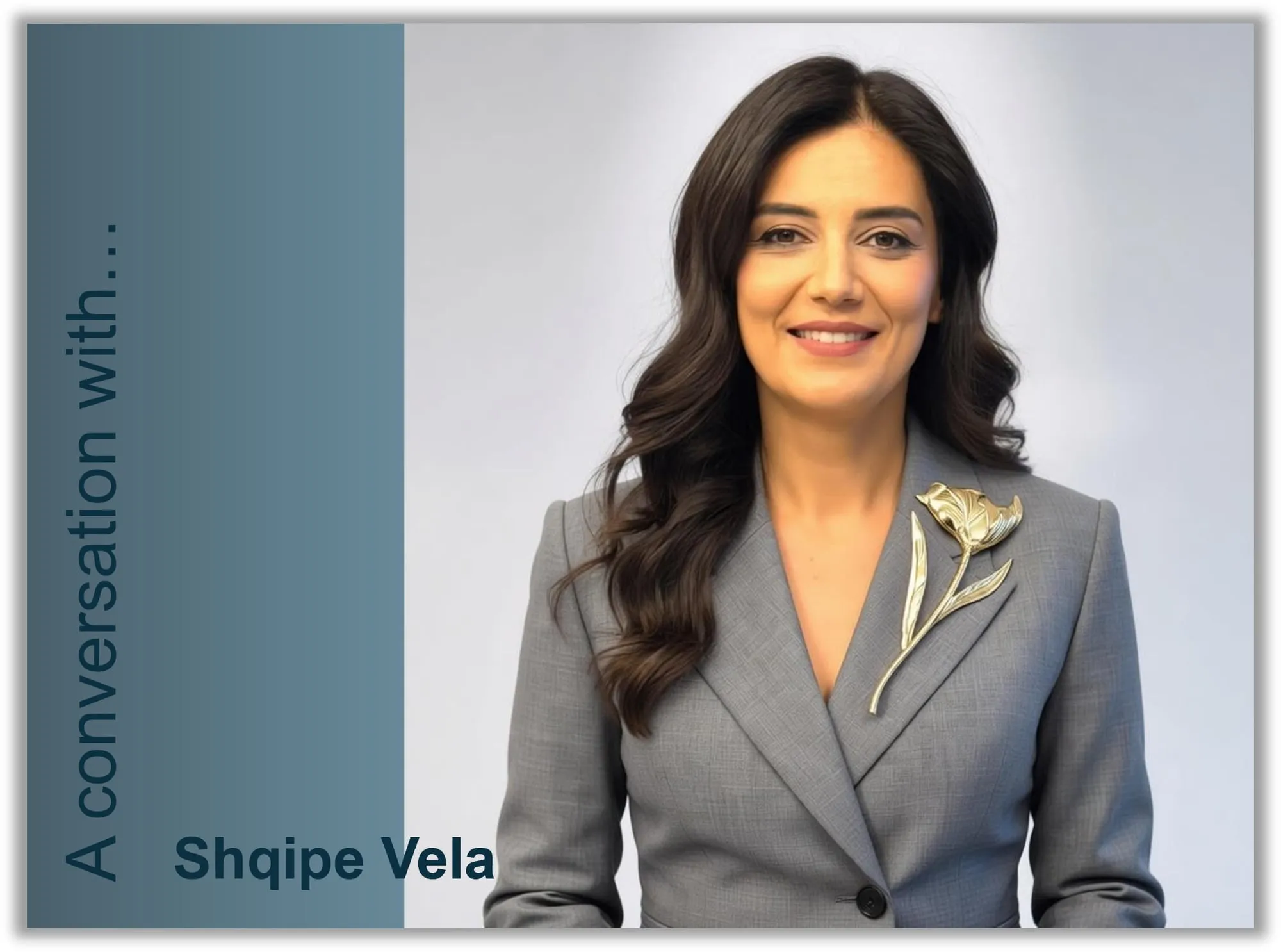
With over two decades of experience at the intersection of energy, governance, and transparency, Shqipe Neziri Vela is a widely respected figure whose work has earned international recognition and awards. She has worked with leading international institutions on energy reform, anti‑corruption, and institutional strengthening, alongside a strong commitment to supporting women in leadership.
In this interview, Shqipe reflects on her professional journey, shares candid insights into what transparency truly means in practice, and discusses the challenges of driving reform in systems that are often resistant to change. The conversation spans governance, the energy transition, leadership under pressure, and the personal realities of building credibility and visibility in high‑stakes environments.
Could you briefly introduce yourself and share a bit about your career journey?
Shqipe Vela: My work sits at the intersection of energy, governance, and transparency, which today are increasingly inseparable in global political economy.
Over the past two decades, my career has evolved from early engagement with environmental and policy issues in Kosovo to leading global programs on transparency in extractive industries at the Extractive Industries Transparency Initiative in Norway. Along this path, I have worked with institutions such as the World Bank, UNDP, UNICEF, the OSCE, and the U.S. Government, focusing on energy reform, anti-corruption, and institutional strengthening.
What has become increasingly clear over time is that energy cannot be understood as a purely technical field. It is a deeply political and economic system that shapes development trajectories, state capacity, and social outcomes.
At the same time, I have remained committed to mentoring and supporting women in the sector. This is not a parallel activity but part of the same logic. If energy systems are to be sustainable and legitimate, they must also be inclusive in terms of who participates in shaping them.
Transparency is a word we hear constantly in governance. In your experience, what does real transparency look like in practice? And at what point does it start becoming more of a buzzword than a reality?
Shqipe Vela: Transparency is often presented as a universal solution to governance challenges, but in practice it is far more complex and often misunderstood.
Real transparency is not simply the act of publishing reports or datasets. It is the creation of an ecosystem in which information is structured in a way that allows it to be understood, interrogated, and used for accountability. In practical terms, this means that data on contracts, revenues, and decision making is not only disclosed but made meaningful to institutions, civil society, and citizens. It also requires institutional capacity to act on that information, otherwise disclosure becomes symbolic rather than transformative.
Transparency becomes a buzzword when it is reduced to procedural compliance. This happens when governments or institutions technically fulfill disclosure requirements, but the information is fragmented, inaccessible, or disconnected from decision making processes. In such cases, transparency exists in form but not in function. Without accountability mechanisms attached to it, transparency risks becoming a performance rather than a reform tool.
When we talk about the energy transition today, there are many assumptions people take for granted. Is there one that you think is fundamentally wrong?
Shqipe Vela: One of the most persistent assumptions about the energy transition is that it is primarily a technological challenge. While technology is essential, it is not the limiting factor.
The real constraints are institutional, political, and regulatory. Energy transitions require stable governance frameworks, credible institutions, and predictable policy environments. Without these, even the most advanced technologies cannot be scaled effectively. This is evident across many regions where renewable energy potential exists, but implementation lags due to regulatory uncertainty or weak institutional capacity.
A second assumption is that the energy transition is automatically inclusive. In reality, transitions can deepen inequality if they are not carefully managed. The benefits of clean energy systems, investment flows, and new technologies do not automatically reach all segments of society. Without deliberate policy intervention, there is a risk that some groups and regions will be left behind, both within and between countries.
In your career, have you ever had a moment when it felt like the system wasn’t just slow to change, but actually resisting it? How did you handle that, and what did you learn from the experience?
Shqipe Vela: Institutional resistance to reform is a structural feature of many governance systems, particularly in sectors such as energy and extractives where economic interests are deeply embedded.
In several instances, efforts to introduce transparency and anti corruption reforms have faced resistance not because of disagreement with the principles, but because they altered established patterns of influence and resource allocation. This resistance often manifests in subtle ways, through delays, procedural obstacles, or fragmentation of responsibility.
What these experiences reinforced is that technical expertise alone is not sufficient to drive reform. Sustainable change requires coalition building across multiple levels, including government institutions, civil society, and international partners. It also requires strategic patience. Effective reform is not only about pushing forward but about understanding institutional timing, political constraints, and the importance of sequencing. In some cases, reframing an issue is more effective than directly confronting it.
If we look specifically at the Balkans, what do you see as the biggest obstacle to meaningful energy reform today? Political courage, institutional capacity, or public trust?
Shqipe Vela: In the Balkans, political courage, institutional capacity, and public trust are tightly interconnected, but if one factor is most decisive, it is political courage.
The region has access to technical expertise, international support, and increasingly aligned policy frameworks with broader European and global energy transition goals. However, implementation often lags due to short term political incentives that prioritize immediate stability over long term reform.
Without sustained political commitment, institutional capacity remains underutilized and fragmented, and public trust continues to erode. Conversely, when political leadership is willing to make difficult decisions and absorb short term costs, it can create a broader enabling environment where institutions strengthen, and trust gradually rebuilds. In that sense, political courage is not isolated. It is the condition that allows other reforms to take root.
You have worked in politically sensitive and high-stakes environments. What kind of leadership does it take to navigate these spaces? And have you ever faced a moment where speaking up could have put your career at risk?
Shqipe Vela: Leadership in high stakes governance environments requires a combination of analytical clarity, institutional discipline, and personal resilience. These are environments where decisions are rarely neutral. They often have distributional consequences and therefore attract competing pressures from different stakeholders. In such contexts, speaking openly about governance risks or transparency challenges can carry professional and political implications.
There are moments when raising difficult issues is not the easiest path. However, credibility in these systems is cumulative and fragile. Once compromised, it is difficult to rebuild. Over time, I have learned that principled leadership is not defined by avoiding pressure, but by managing it without losing coherence in values and judgment. While this may sometimes slow immediate progress, it strengthens long term influence and institutional trust.
Have you ever been underestimated or doubted? Not because of your ideas, but because of who you are or where you come from. How did you face that, and did it shape the way you approach your work today?
Shqipe Vela: In many professional environments, especially in technical and policy heavy sectors such as energy, bias is often implicit rather than explicit. Being a woman in a predominantly male field, and coming from a smaller country, has at times meant that assumptions about credibility needed to be addressed more directly. This requires a consistent focus on preparation, depth of knowledge, and evidence-based contribution.
Over time, these experiences shift from being individual challenges to shaping a broader understanding of structural barriers in institutions. They also reinforce a responsibility to create pathways for others. This is particularly important for women and younger professionals who may face similar barriers. The goal is not only individual advancement, but gradual transformation of the professional environment itself.
Today, personal visibility and reputation can play a big role. How easy is it to build a credible brand name?
Shqipe Vela: In today’s interconnected policy and governance environment, visibility is more accessible than ever due to digital platforms and global networks. However, reputation remains fundamentally slow to build and difficult to sustain. Credibility is not a function of visibility alone. It is built through sustained engagement, consistency of judgment, and demonstrated expertise over time. In many ways, it is accumulated quietly rather than publicly.
There is also a growing tension between visibility and substance. The risk in contemporary professional environments is the prioritisation of communication over contribution. Yet in fields such as energy and governance, long term trust depends on depth, not presence. Reputation, therefore, is best understood as the outcome of sustained work rather than its objective.
For people who want to create real change in complex systems, what qualities matter most? And what is one hard truth about governance and transparency you would share with a young professional hoping to follow in your footsteps?
Shqipe Vela: Creating meaningful change in complex governance systems requires a combination of analytical rigor, institutional patience, and ethical consistency. It also requires an ability to operate in environments where outcomes are uncertain and progress is often nonlinear. One of the central truths of governance and transparency work is that progress rarely appears in real time. It is incremental, uneven, and sometimes reversible. However, these incremental changes matter. Improvements in data systems, regulatory frameworks, institutional accountability, and inclusiveness accumulate over time into structural transformation. For emerging professionals, the most important investment is depth rather than immediacy. Real impact is rarely visible in the short term. It often emerges through sustained, and at times invisible, institutional work that gradually shifts how systems function.